Flip Core — a smart signal bot for binary options
Theory
Flip Core is a universal signal tool that can solve two main trader tasks:
- Helps you see where the trend really wants to reverse;
- Suggests where you can add to a position with the trend without guessing — getting a confident entry instead.
At the core of the signal bot is a dynamic line that adapts to volatility. A Flip signal is not an attempt to guess; it’s a fixation of price transitioning to the other side — a conditional level breakout.
When the re-entry mode (trend-following) is enabled, a line retest (bounce) occurs, an extremum gets broken (breakout), or a short RSI reset happens. Noise is cut by quality filters (slope, spikes, chop, adequate-volatility corridor, higher-TF trend, cooldown). Any filter is available to the user and they can be used simultaneously. The waiting horizon is dynamic: a strong start means a short TTL.
How it works
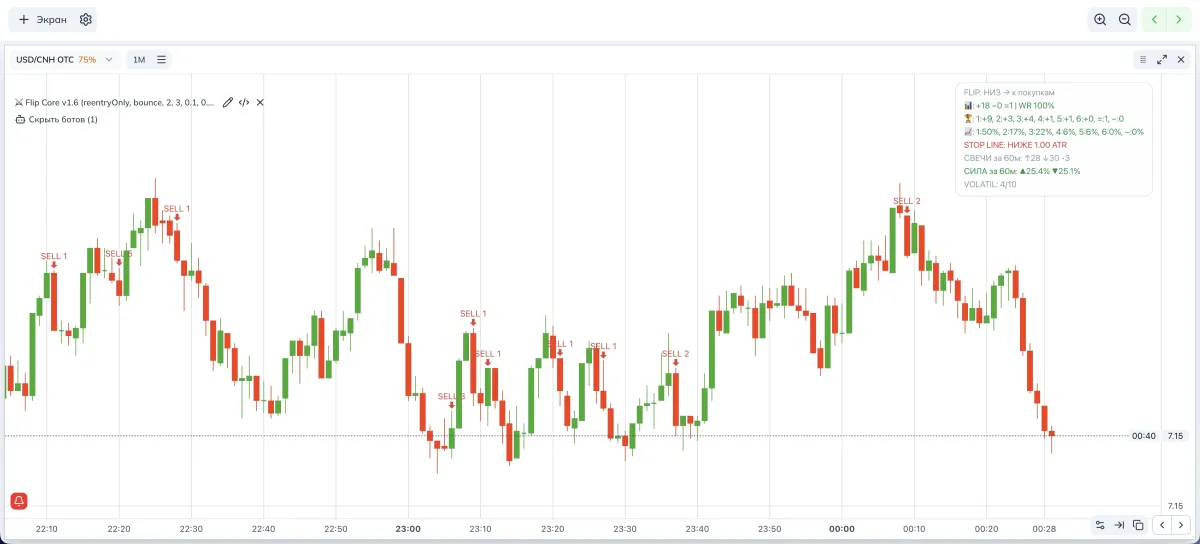
- Flip appears upon a real side change relative to the dynamic line.
- Re-entry — a trend-following add after Flip, three trigger variants (retest, breakout, RSI-reset).
- Filters prevent signal overspam and can reshape bot logic both in noisy markets and at inadequate volatility.
- Statistics are kept transparently; the attempt number in the label is shown only on a win — the chart stays clean.
- HUD hints at market state and notifies the trader if results drop below a threshold.
Visual parameters
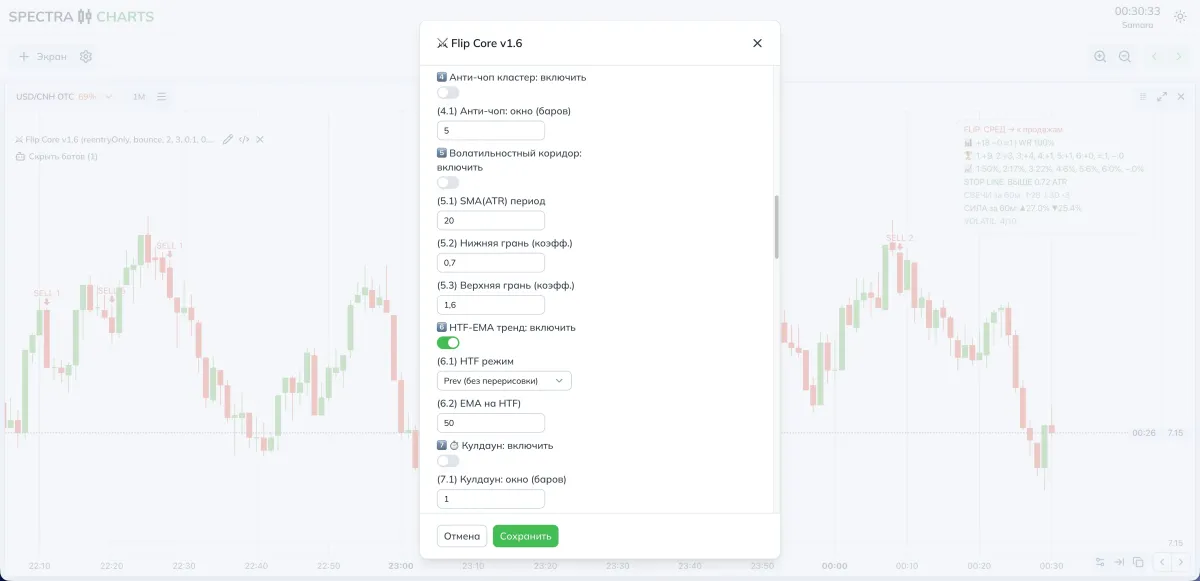
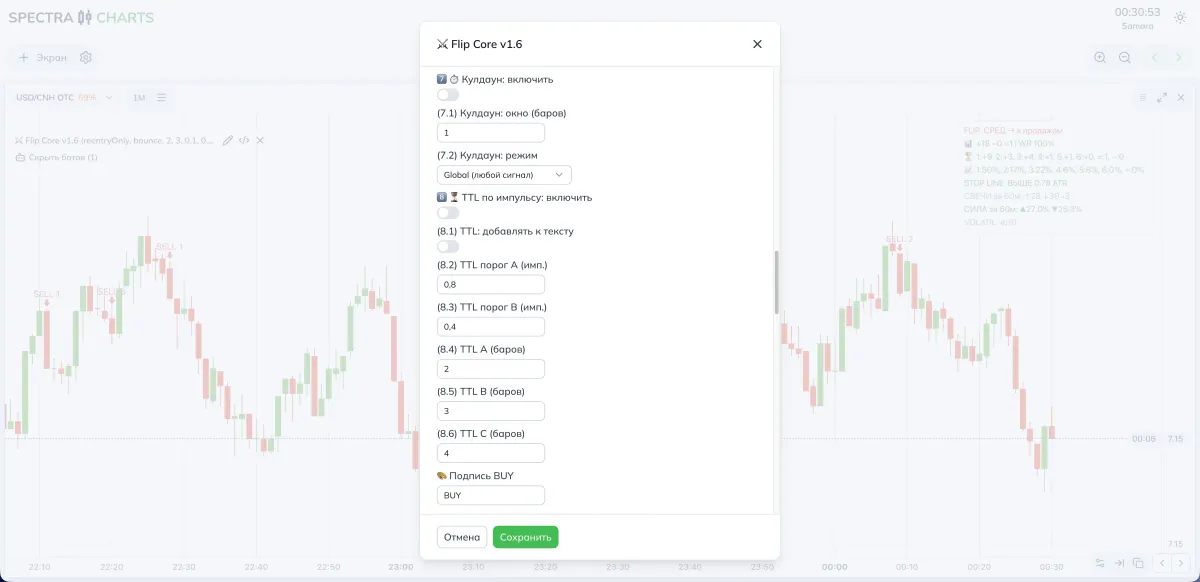
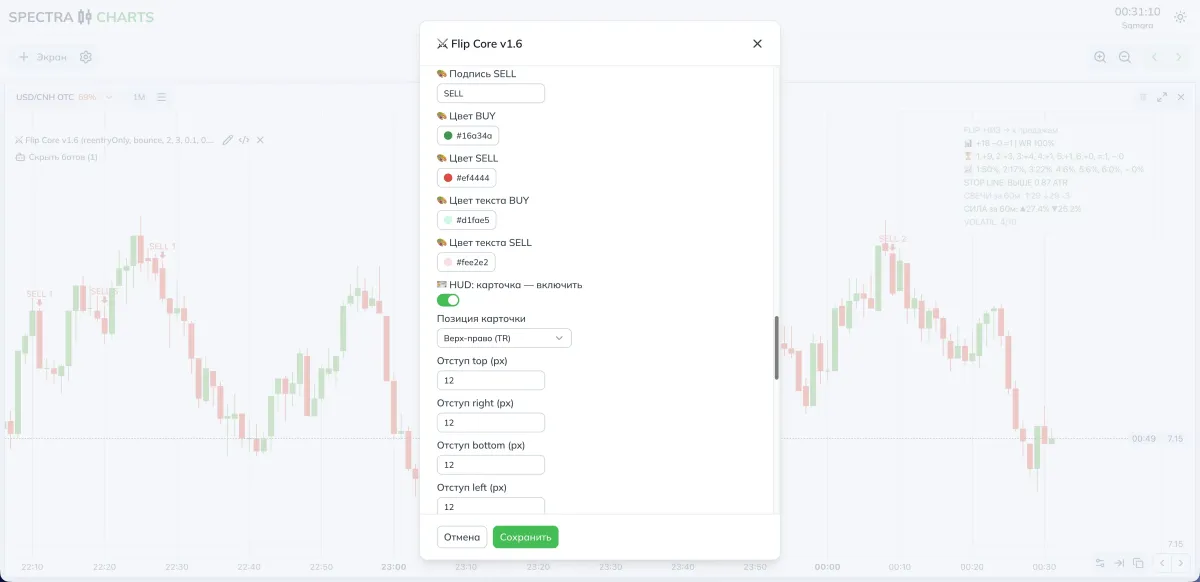
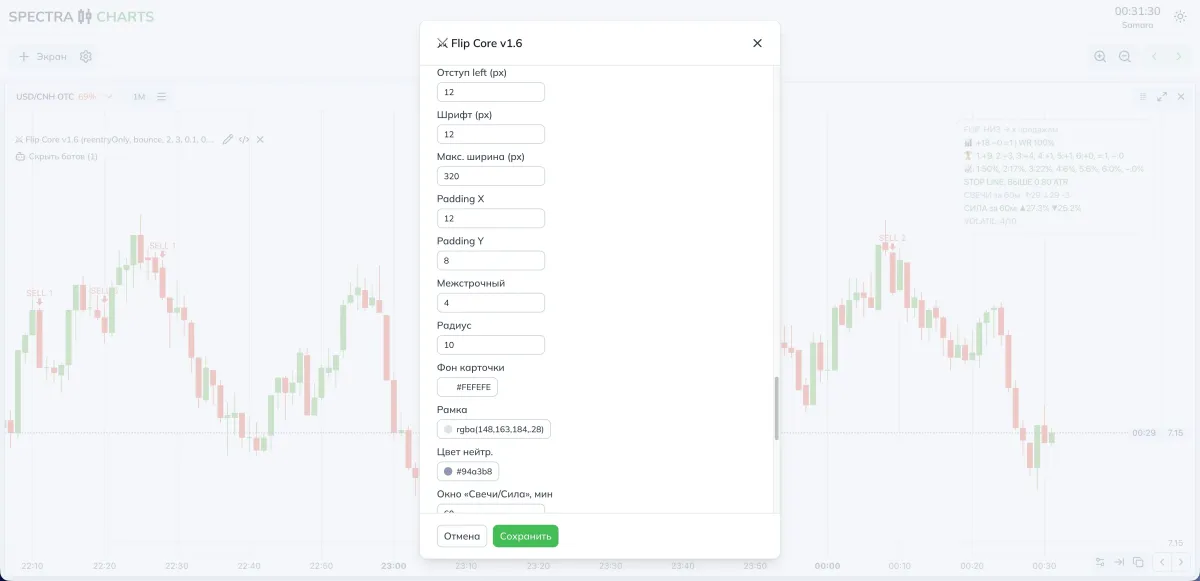
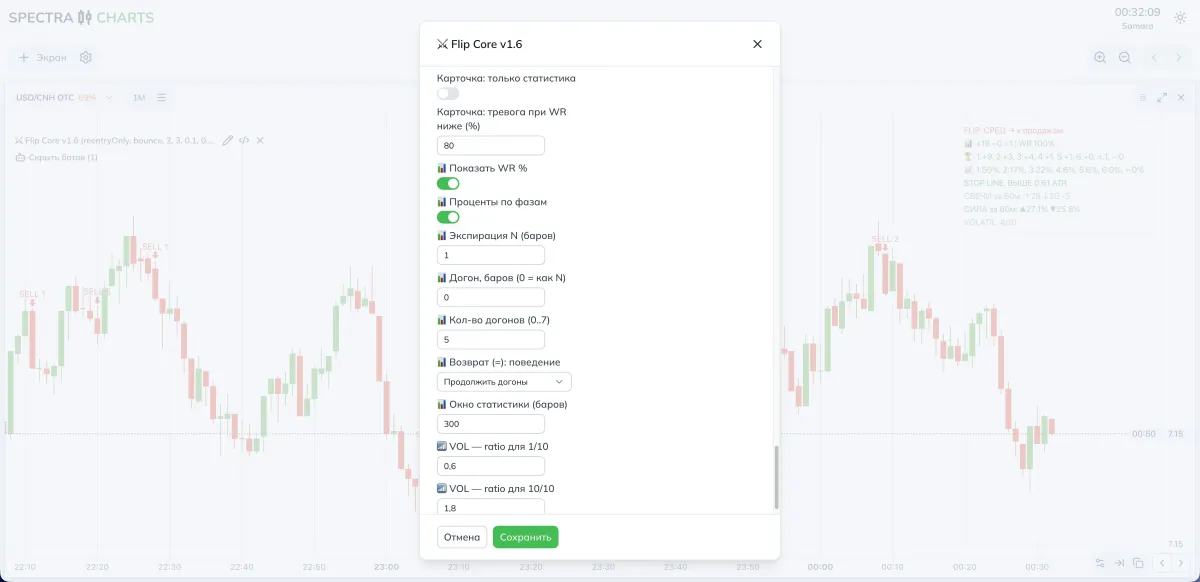
Parameters and impact
Dynamic line foundation
| Parameter | What it does | Effect |
|---|---|---|
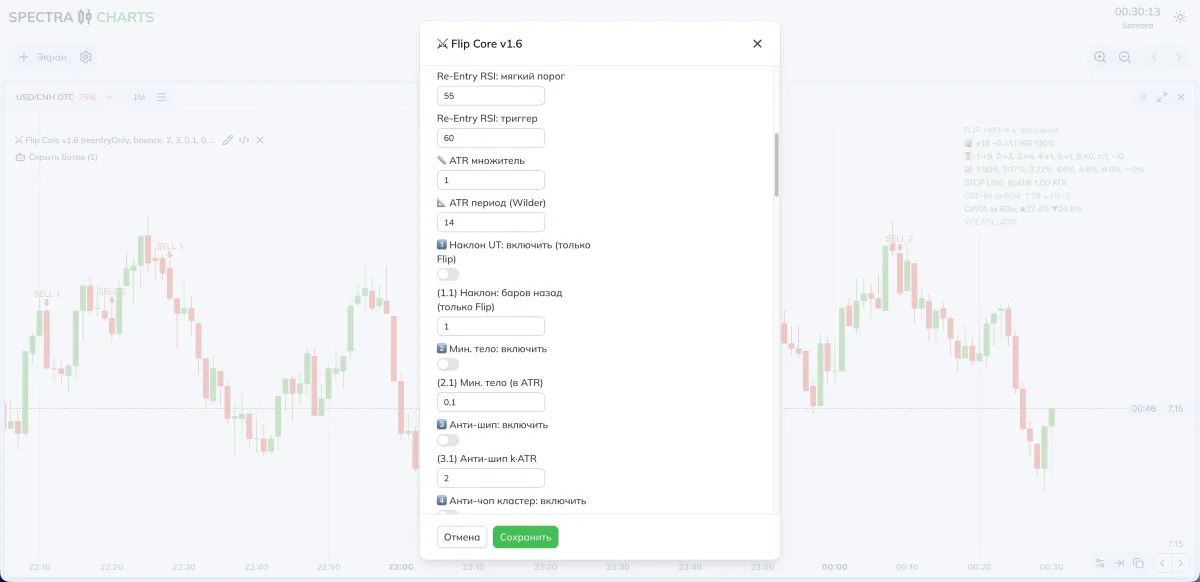
| ATR multiplier | Line sensitivity to volatility | The higher — the wider the “breathing,” fewer false flips but later entries |
| ATR period | Volatility smoothing | Bigger period — more stable line, but slower reaction |
Signal mode
| Parameter | What it does | When to choose |
|---|---|---|
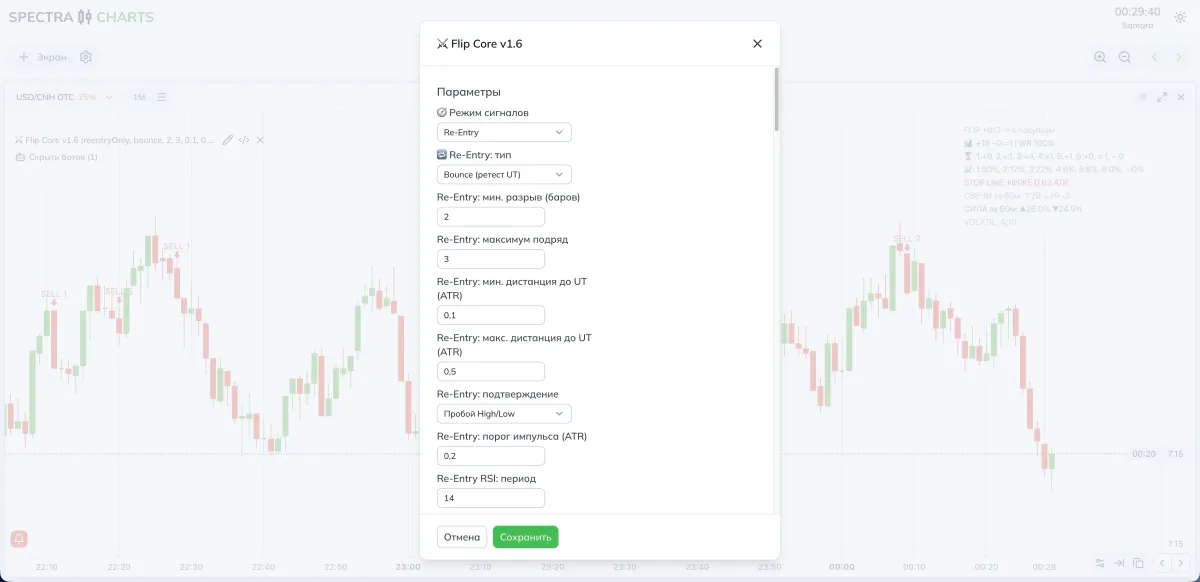
| Signal mode | Flip only / Flip+Re-entry / Re-entry only | For discipline — “Flip only”; for aggressive adds — “Flip+Re-entry” |
Re-entry (adding with the trend)
| Parameter | What it does | Tip |
|---|---|---|
| Re-entry type | Bounce (line retest), Breakout (HH/LL update), RSI-reset | Range — bounce; trend — breakout; soft trigger — RSI-reset |
| Gap between entries | Minimum bar interval before the next re-entry | Protection from “bursting” in chop |
| Max in a row | Limit of re-entries to one side | Keeps risk under control |
| Min/Max distance to line | Allowed price distance corridor to UT for re-entry | Too close/far — skip |
| Confirmation | Break of high/low, engulfing, or candle impulse | Match the market: impulsive — break; uneven — engulfing |
| Impulse threshold | Minimum candle strength for confirmation | Raise the threshold in “shaky” conditions |
| RSI period / thresholds | RSI-reset logic (soft threshold and trigger) | Lower thresholds for more frequent restarts |
Quality filters (1…7)
| Parameter | What it does | When to strengthen |
|---|---|---|
| Line slope | Requires line movement in the entry direction | Fine in trend; can be softened in ranges |
| Min. candle body | Filters out “empty” bars | If there are many “forgotten” arrows |
| Anti-spike | Cuts needle candles | On news and “nervous” assets |
| Anti-chop cluster | Skips repeat signals in a short window | When “chop” forms at a level |
| Volatility corridor | Operate only within an adequate volatility band | If you catch “silence” or “hurricanes” |
| Higher-TF trend | Align with the higher direction | For trend trading |
| Cooldown | Pause between signals (by side or global) | If you tend to “click” in a row |
TTL and timing
| Parameter | What it does | Practice |
|---|---|---|
| TTL by impulse | Strong start — shorter wait; weak — longer | Shorter more often on OTC; on the market — watch context |
| Add TTL to label | Writes TTL right into BUY/SELL | Leave off for a clean visual |
Visibility and markers
| Parameter | What it does | Notes |
|---|---|---|
| BUY/SELL labels/colors | Taste and readability | Contrast with the background, keep text short |
| Marker text colors | Font contrast for markers | Light text for dark themes |
HUD and analytics
| Parameter | What it does | Tip |
|---|---|---|
| Show card | Enables HUD in a chart corner | For discipline — must have |
| Position/margins/font | Card layout | Fit to your chart layout |
| Stats only | Mode without “context” rows | If you want minimalism |
| Window “Candles/Strength” | How many minutes to compute local metrics | Match your TF |
| WR alert threshold | HUD highlight when results drop | A good anchor to “hit the brakes” |
Statistics and re-entry
| Parameter | What it does | Note |
|---|---|---|
| Expiration | Result evaluation horizon | For binaries — start with one candle |
| Re-entry step | Attempt window after the first | Step equal to base expiration is the clearest |
| Number of re-entries | How many attempts are allowed | Discipline > frequency |
| Return (=) | Behavior on zero outcome | “Repeat” reduces stats noise |
| Show WR/percentages | Display totals and attempt breakdown | Enable for HUD |
| Statistics window | History depth for calculations | Make it comparable to your TF |
VOL scale (indicative)
| Parameter | What it does | Why |
|---|---|---|
| Lower/upper bounds | Normalizes current vol into a 1…10 scale | Handy to see “quiet/hot now” in HUD |
Practical presets
- Base — Flip, re-entry — bounce.
- Cooldown — global.
- Anti-spike and anti-chop — enabled.
- Volatility corridor — moderate.
- HUD — summary and WR alert.
- Base — Flip + breakout for impulse adds.
- Higher-TF trend — enabled (non-repainting mode).
- Cooldown — by side.
- Filters — slope + min. candle body.
- TTL — dynamic, label without overload.
Combinations
- EMA ribbon (Trend Signals): take Flip strictly with the ribbon side; re-entry — after a local impulse.
- Stoch Levels Overlay: timing by 20/80 zones — re-entry with the trend, skip against it.
- Range Detector: in ranges, “bounce” works better at the edge; in trend — “breakout.”
Basic entry rules
Context. Determine the side: Flip + alignment with the higher TF or EMA ribbon.
Trigger. The Flip itself or the chosen re-entry.
Filter. Cut needles, chop, and inadequate volatility.
Timing. On short TFs — one candle; as volatility rises don’t stretch duration — look at impulse strength.
Risk. Fixed trade size, cooldown after a series.
FAQ
Yes. Quality filters cut multiple flips (buy/sell jumps) and wicky candles. The goal is fewer but cleaner.
No retest — no bounce; no extremum update — no breakout; RSI not overheated — no reset. It’s protection from extra signals.
To keep the chart readable and show on which attempt the trade closed in profit. All outcomes are in the stats/HUD; the marker emphasizes only the result.
In a sustained trend — almost always. In a tight range you can soften it so as not to miss setups inside the range.
Spectra Charts — overview of the platform and all its features
Complete guide to Spectra Charts: what this tool is, how screens are structured, bulk actions, settings, the bots and indicators catalog, adding tools to the chart and managing them.
Trading Bot Streak Hunter — entry against a streak of same-colored candles
Searching for streaks of candles of one color and a counter-trend entry at the “inflection.” Bot logic, parameter impact, recommendations for OTC and the real market, and a trading plan.