Binary options, what it is. Complete glossary of terms and their definitions
Starting in a new field is never easy: there are many unfamiliar words and abbreviations around that make it difficult to understand even simple instructions. This material is your “translator” into plain language. Below you will find a structured glossary of binary options terms with clear definitions, examples, and tips. It will be useful both when taking your first steps on Pocket Option, and at the stage of systematic learning.
A brief history of the appearance of binary options.
The first mentions of binary options date back to the early 20th century in the context of the development of US financial markets. The Great Depression period gave birth to many new derivatives, most of which turned out to be overly risky and poorly predictable, so over time they disappeared.
Options trading as a whole survived and began to be perceived as a promising tool. In 2008, in the USA, regulators allowed the exchange launch of certain binary contracts. After that, the Chicago Board Options Exchange (CBOE) and the North American Derivatives Exchange (Nadex) began offering standardized binary options to retail traders.
In the 2010s, binary options became more accessible to the general public through numerous online platforms, including unlicensed ones. This led to a sharp rise in popularity thanks to the simplicity of the interface and the idea of a “quick” result. At the same time, regulatory oversight increased due to the high level of risk and cases of fraud by unscrupulous brokers.
Current status and regulation
Today there are three main categories of options as financial instruments:
- Exchange-traded options — classic “vanilla” options traded on regulated exchanges.
- Regulated binary options — available only on regulated venues.
- Unregulated binary options — online platforms without oversight by authoritative financial bodies.
Most beginners and many experienced traders use unregulated binary options due to wide availability, simplicity, and a low entry threshold. This does not mean that users are obliged to lose money, however the risk is significantly higher, and service quality depends on the broker’s integrity. Among unregulated companies there are participants who have fulfilled obligations for years and have a wide client base, but the choice of partner must be especially careful.
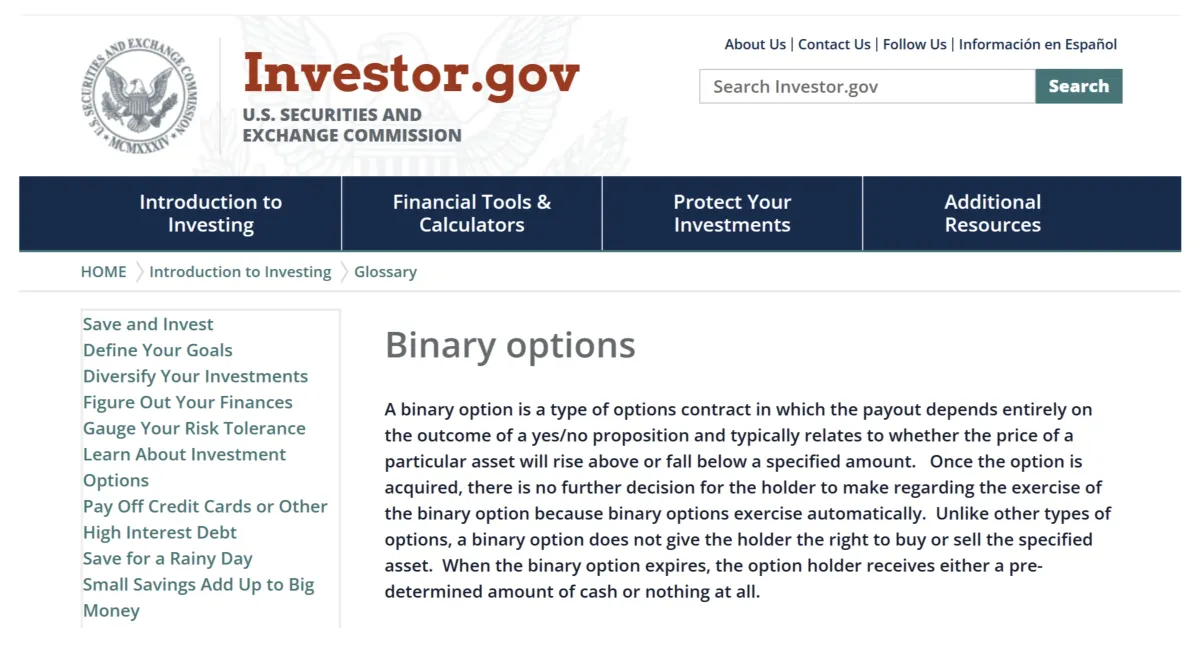
On the website of the U.S. Securities and Exchange Commission (SEC), binary options are described as a fully-fledged but high-risk trading instrument.
How binary options differ from “vanilla” options and other markets
In traditional exchange “vanilla” options, you buy a contract with a price that depends on how much the underlying asset changes. In binary options you do not become the owner of the underlying asset and do not calculate a complex payout. The result is a fixed payout if the forecast of direction is correct by the moment of expiration, or the loss of the trade amount if wrong. This difference makes binary options simpler in mechanics and allows you to assess potential profit and loss in advance. That is what distinguishes them from the forex market and from the crypto and stock markets.
Regulation by countries and warnings
Today, trading in binary options falls under legal norms in many countries. This increases transparency and safety on regulated venues. At the same time, a number of regulators publish risk warnings, and in some jurisdictions binary options are restricted or prohibited.
Nevertheless, despite the controversial status in certain regions, binary options remain an attractive tool for experienced traders who consciously approach risk and use proven strategies with statistics taken into account.
Practical recommendations for choosing a platform
- Check the broker’s reputation based on independent sources and the company’s lifetime.
- Study the conditions for deposits and withdrawals, commissions, and order processing speed.
- Start with a demo account and a fixed trade size.
- Do not use high-risk strategies without systematic risk management.
- Clarify tax obligations at your place of residence before starting to trade.
General terms of binary options
- Asset — a financial instrument for which a trade is opened: currency pair, stock, commodity, index, cryptocurrency. For example: EURUSD
- Bars (Bars) — a type of chart where each “bar” shows the price range for a period, with marks of open, close, maximum and minimum point. Essentially, bars are an analogue of Japanese candles, but they look not like rectangles, but like vertical lines.
- Balance — the amount of funds in the account at the current moment (includes closed results).
- Exchange — a venue where assets are traded in real time.
- Exchange asset — a real market instrument with a price formed from supply and demand in the international market.
- Binary option (Binary Option) — a “higher/lower” contract for a fixed time. The result is a fixed payout with a correct forecast or loss of the trade amount with an incorrect one.
- Bots — algorithms that give BUY/SELL signals according to set logic (on the chart, website, or in a Telegram bot).
- Broker — a company providing access to the platform and quotes.
- Verification (Verification) — identity confirmation (photo of a document, selfie).
- Payout (Payout) — the percentage of profit for a successful trade (for example, 80% of the trade amount).
- Chart — a visual display of price changes over time.
- Deposit (Deposit) — funds deposited into the account.
- Closed trades — trades whose expiration has passed and the result is known.
- Indicators (Indicators) — mathematical tools for price analysis (help find entry points).
- Drawing tools — manual lines/levels/shapes on the chart for analysis.
- Quote (Quote) — the current price of an asset.
- Buy (BUY) — a forecast for a rise by the moment of expiration.
- Line chart (Line Chart) — a one-line chart by closing prices, also a tick chart that displays trades in real time.
- Trade multiplier — an increase in volume without directly increasing the trade amount, the increase occurs by the multiplier you choose, for example: x1.2.
- Market sentiment (Market Sentiment) — the percentage of “up/down” trades among platform users.
- Trading volume (Volume) — the number of trades or the amount of funds for the displayed period.
- Open trades — active trades until the moment of expiration (until trade closure).
- Oscillators (Oscillators) — indicators with oscillations within a range (overbought/oversold). Oscillators are located in an additional window under the chart.
- OTC asset (OTC Asset) — an instrument with a price formed inside the platform outside the real market, often available 24/7.
- Pip (Pip) — the minimum possible price change (usually 0.0001 for currencies, 0.01 for stocks/commodities, depends on the chosen asset).
- Point — the same as pip (contextually — a “step” of price).
- Profit (Profit) — a positive trade result (payout minus the trade amount).
- Candle (Candle) — a chart element with a body (between open and close) and shadows (minimum/maximum).
- Candlestick analysis (Candlestick Analysis) — searching for signals by candle shapes, patterns, and their combinations.
- Trade (Trade) — opening a “higher/lower” position (buy/sell) for a time.
- Social trading (Social Trading) — copying the trades of other traders.
- Trade amount — the volume used in one operation.
- Trade amount in currency — expression of the amount in the account currency (for example, 5 USD).
- Trade amount in percent — the volume as a percentage of the current balance (for example, 2% of the deposit).
- Timeframe (Timeframe) — the period of one candle’s formation (M1, M5, H1, etc.).
- Trade history (Trade History) — a list of closed trades with results.
- Trading session (in a global context) — a period of market activity (Pacific, Asian, European, American).
- Trading session (in the context of one trader’s work) — a period of trading activity chosen by the trader for market analysis and opening trades. During your own trading session it is recommended to adhere to Risk Management.
- Trading strategy (Trading Strategy) — a set of entry/exit rules.
- Turnover (Turnover) — the total volume of trades for a period.
- Trading profile — a set of a user’s trading results for a selected period (assets, timeframes, risk).
- Trading signal (Signal) — a mark/notification of a potential entry into a trade.
- Trader (Trader) — a person who makes trades for profit.
- Trading (Trading) — the process of analysis and opening trades.
- Heikin Ashi (Heikin Ashi) — a type of candles with trend smoothing.
- Expiration (Expiration) — the time of auto-closing a trade and fixing the result.
- Expiration by flag — closing by the platform’s internal timer to the nearest fixed moment of simultaneous closing of one of the subsequent candles.
- Expiration by timer — closing strictly after the set time from the moment of entering a trade.
Expiration: two approaches
| Type | How it works | When to apply |
|---|---|---|
| By flag | Until the next fixed platform time | For synchronization with “step” times and simultaneous trade closing with candles |
| By timer | Exactly after the specified seconds/minutes from entry | For precise tuning to the strategy |
Capital management (Money / Risk Management)
- Anti-Martingale (Anti-Martingale) — increase the trade amount after profit, decrease after loss.
- Balance — the current amount of funds in the account.
- Breakeven (Break-Even) — zero total profit/loss. Closing a trade at the entry point.
- Deposit (Deposit) — funds in the account.
- Dogon (Martingale Step) — increasing the amount after a loss to cover past losses.
- Money management (Money Management) — rules for capital allocation.
- Martingale (Martingale) — systematic increase of the trade size after a loss.
- Drawdown (Drawdown) — a decrease of the balance from the initial one in the trader’s current trading session.
- Recovery (Recovery) — restoration after a drawdown. Returning to breakeven or profit.
- Risk management (Risk Management) — strict adherence to limits of amount per trade, daily losses, number of trades. Strict adherence to your own rules of deposit allocation and compliance with the trading strategy.
- Winning streak (Winning Streak) — several profitable trades in a row.
- Losing streak (Losing Streak) — several losing trades in a row.
- Trade amount — the volume of capital in one operation/trade.
- Time management (Time Management) — trading and rest schedule to reduce emotional mistakes.
Technical analysis
- ATR (Average True Range) — average volatility over a period.
- Sideways market (Range) — a narrow range without a pronounced trend. Price moves “back and forth”.
- Volatility (Volatility) — the speed and amplitude of price change. Higher volatility means the chart moves up and down more strongly, lower volatility — the chart moves slowly, it can move leisurely in one direction along the trend.
- Inside bar (Inside Bar) — a candle entirely inside the previous candle’s range.
- Impulse (Impulse) — a fast movement in one direction, usually looks like long candles relative to neighboring ones.
- Correction (Correction) — a reverse movement against the trend.
- Impulse-correction — a relationship in which a correction always follows an impulse, and vice versa. Essentially this is a basic pattern for trading strategies whose goal is to enter a trade after a correction expecting continuation of the original impulse.
- Trend line (Trend Line) — a straight line through minimum/maximum points on the chart.
- False breakout (False Breakout) — a move beyond a level with a quick return to the previous level.
- Order block (Order Block) — a zone of large buys/sells (pending buy/sell orders).
- Rebound (Rebound) — a reversal after touching a level.
- Pattern (Pattern) — a repeating shape, figure, combination of candles with a certain meaning (for buy or for sell).
- Pin bar (Pin Bar) — a candle with a long shadow and a small body.
- Engulfing (Engulfing) — a new candle completely overlaps the body of the previous one.
- Price action (Price Action) — analysis of clean price without indicators.
- Breakout (Breakout) — moving beyond support/resistance.
- Reversal (Reversal) — a change in trend direction.
- Candlestick patterns (Candlestick Patterns) — combinations of candles for signals.
- Swing (Swing) — movement from a local minimum to a maximum and back.
- Average volatility (ATR) — see ATR.
- Trend (Trend) — a stable direction: up, down, sideways.
- Support level — a zone of stopping a fall and a probable rise.
- Resistance level — a zone of stopping a rise and a probable decline.
- Flat (Flat) — sideways movement without directionality.
Indicators and oscillators
- ADX (Average Directional Index) — trend strength.
- AO (Awesome Oscillator) — impulse and direction.
- ATR — average amplitude of fluctuations.
- Bollinger Bands — average + upper/lower range boundaries.
- CCI — overbought/oversold.
- Donchian Channel — extremes over a period (breakouts).
- EMA — exponential moving average.
- Envelopes — a channel at a fixed percentage from the average.
- Fractals — local reversals (peaks/troughs).
- Ichimoku Cloud — trend, levels, impulse in one indicator.
- MACD — divergence/convergence of averages, trend strength.
- Momentum — speed of price change.
- OBV — the relationship of volume and price movement.
- Parabolic SAR — direction and potential reversals.
- RSI — overbought/oversold zones.
- SMA — simple moving average.
- Stochastic Oscillator — price position within the range.
- SuperTrend — dynamic color change when the trend changes.
- TSI (True Strength Index) — trend strength with double smoothing.
- VWAP — volume-weighted average price.
- Williams %R — an analogue of RSI by range.
- ZigZag — a filter of small fluctuations, highlights structure.
- Volume Profile — distribution of volume by price levels.
Trading approaches and styles
- Trade opening time — the entry point “buy/sell”.
- Delay (Lag) — a lag in displaying a trade/chart or price calculation.
- Intraday (Intraday) — all trades within one day.
- Combined strategy — combining several methods/indicators.
- Counter-trend (Counter-Trend) — entries against the trend (usually from levels).
- News (News) — important events from the economic calendar that affect price.
- Repainting (Repainting) — changing indicator signals on history.
- Reversal strategy — reading a signal as a reversal.
- Setup (Setup) — a set of conditions for entry.
- Scalping (Scalping) — quick trades with short expiration.
- Entry timing — the precise choice of the candle/second for entry.
- Trading session — Pacific, Asian, European, American.
- Trading on a pullback (Pullback) — entry after a correction.
- Trading on a breakout (Breakout) — entry when moving beyond a level.
- Trading from a level (Level Trading) — entry by pre-marked levels.
- Trend following (Trend Following) — trades in the direction of the trend.
- Signal filtering — discarding weak signals by rules/indicators.
- Economic calendar — a list of important publications around the world.
- Swing trading (Swing Trading) — holding trades from hours to days.
Analytics and statistics
- Asset yield (Asset Yield) — the payout percentage by asset.
- Equity curve (Equity Curve) — change of balance over time.
- Number of trades (Trade Count) — the number of operations over a period.
- Expectation (Expectancy) — the average result of one trade.
- Profit Factor — the ratio of total profit to total losses (>1 — better).
- Series of trades (Trade Series) — a sequence of trades to assess stability.
- RR (Risk-Reward Ratio) — potential profit to risk.
- Probability (Probability) — the chance of a trade ending in profit.
- WR (Win Rate) — the share of profitable trades in percent.
Services and tools
- Spectra Charts — charts, indicators, bots, and analytics for binary options.
- Bot Builder — a constructor of signal bots without programming according to your logic.
- Enigma — analytics of strategies and signal efficiency.
Psychology of trading
- Greed (Greed) — the desire to “squeeze out more,” leading to breaking rules.
- Breakeven (Break-Even) — the psychological goal to “get to zero” at any cost.
- Faith in the market (Market Faith) — confidence in a strategy after temporary failures.
- Deposit (Dep) — funds in the account for trading.
- Re-deposit (Re-Deposit) — repeated top-up after losses.
- Overtrading (Overtrading) — too many trades without a clear signal.
- Motivation (Motivation) — the internal reason to maintain discipline.
- Expectations (Expectations) — inflated projections leading to disappointment.
- Trading plan (Trading Plan) — rules of entry/exit/risk.
- Psychological drawdown — fatigue/insecurity after a series of losses.
- Loss acceptance (Loss Acceptance) — a calm attitude to losses as part of the process.
- Self-control (Self-Control) — following rules without emotions.
- Squeeze (Squeeze) — a sharp short price jump.
- To drain — to lose part or all of the deposit.
- Deposit drain — complete loss of funds.
- Stop-loss (psychological) — a daily loss limit after which trading is stopped.
- Fear of loss (Fear of Loss) — prevents entering on a signal.
- Take-profit (daily) — the profit target for a day/session.
- Patience (Patience) — the ability to wait for strong signals.
- Tilt (Tilt) — impulsive actions after a failure.
- Trading session — a personally allocated time segment for trades.
- Trading day — one working day with goals and limits.
- Entry point (EP, Entry Point) — the price/moment of entry.
- Confidence (Confidence) — calmness and belief based on experience.
- FOMO (FOMO) — fear of missing out.
- Hedge (Hedge) — reducing risk/covering the loss of the previous trade with a counter position.
- Cold calculation (Cold Logic) — decisions based on facts, not emotions.
- Emotional discipline — keeping calm with any outcome.
- Emotional trading (Revenge Trading) — “to take revenge on the market” after a loss.
How to use this glossary in practice
Step 1. Parse the basics
Go through the sections “General terms” and “Capital management”. Fix simple risk rules.
Step 2. Choose indicators
For example, 1–2 indicators or trading bots. Do not overload the chart.
Step 3. Assemble a simple setup
Describe in words the conditions for BUY/SELL and expiration. Form a checklist, writing it down in a notebook.
Step 4. Test on demo
Trade one strategy for at least a week and record the results.
Step 5. Connect analytics
Watch WR, Profit Factor, expectancy. Change one parameter at a time.
No. In trading, decisions are made according to rules and statistics, not “by luck”. However, risks are high, discipline and learning are mandatory.
Create an account and pass verification, switch to demo, choose one simple setup and collect statistics. Keep the trade size fixed.
No. For a start, simple tools and clear rules are enough. Increase complexity gradually.
Tools and learning — PoSignals
Charts, signals, a bot constructor, and educational materials for a calm start.
How to withdraw money from Pocket Option to the BingX exchange and exchange cryptocurrency for rubles
A detailed guide on withdrawing funds from Pocket Option in USDT TRC20 cryptocurrency to the BingX exchange and then selling via P2P to receive rubles on a bank card.
How to top up your Pocket Option deposit with cryptocurrency via BingX
Step-by-step guide to safely topping up your Pocket Option deposit from the BingX exchange: choosing the method, transferring USDT on the TRC20 network, checking the transaction, and important nuances.